How One Team Wired Firecrawl Into a Live AI Research Agent
Turning a static AI assistant into a market-intelligence engine that never goes stale, using Firecrawl's search, scrape, and agent endpoints as its real-time data layer.

The problem: a smart agent with stale eyes
The client — a growth team at a B2B software company — had already built an internal AI assistant on top of a capable language model. It could summarize documents, draft outreach, and answer general questions well. But the moment anyone asked it something that depended on the current state of the world — "what's this competitor's latest pricing page say," "has this company announced funding recently," "what's currently trending in our category" — it either declined, or worse, answered confidently using stale information baked into the base model's training data.
That gap mattered. The team's actual job — competitive and market intelligence — is inherently about what changed this week, not what was true whenever the model was last trained. A research agent that can't see the live web isn't a research agent; it's a search engine that lies convincingly when it doesn't know something.
Why Firecrawl
We evaluated a few approaches to giving the agent live web access, and landed on Firecrawl as the data layer for three concrete reasons:
- It returns clean, structured content, not raw HTML. Firecrawl's
/scrapeendpoint converts any URL — including JavaScript-heavy pages most naive scrapers choke on — into clean markdown or structured JSON, which is exactly the format a language model consumes best. - It covers the full research loop, not just fetching one URL. The
/searchendpoint handles "I don't know the URL yet" queries,/crawlhandles "pull this whole section of a site," and the/agentendpoint handles fully open-ended prompts like "find recent funding announcements for these five companies" without the agent needing to manage URL discovery itself. - It's built for exactly this use case. Firecrawl markets itself directly as web data infrastructure for AI systems, with SDKs that drop straight into an agent's tool-calling loop rather than requiring a custom scraping layer to be built and maintained in-house.
How the pipeline works
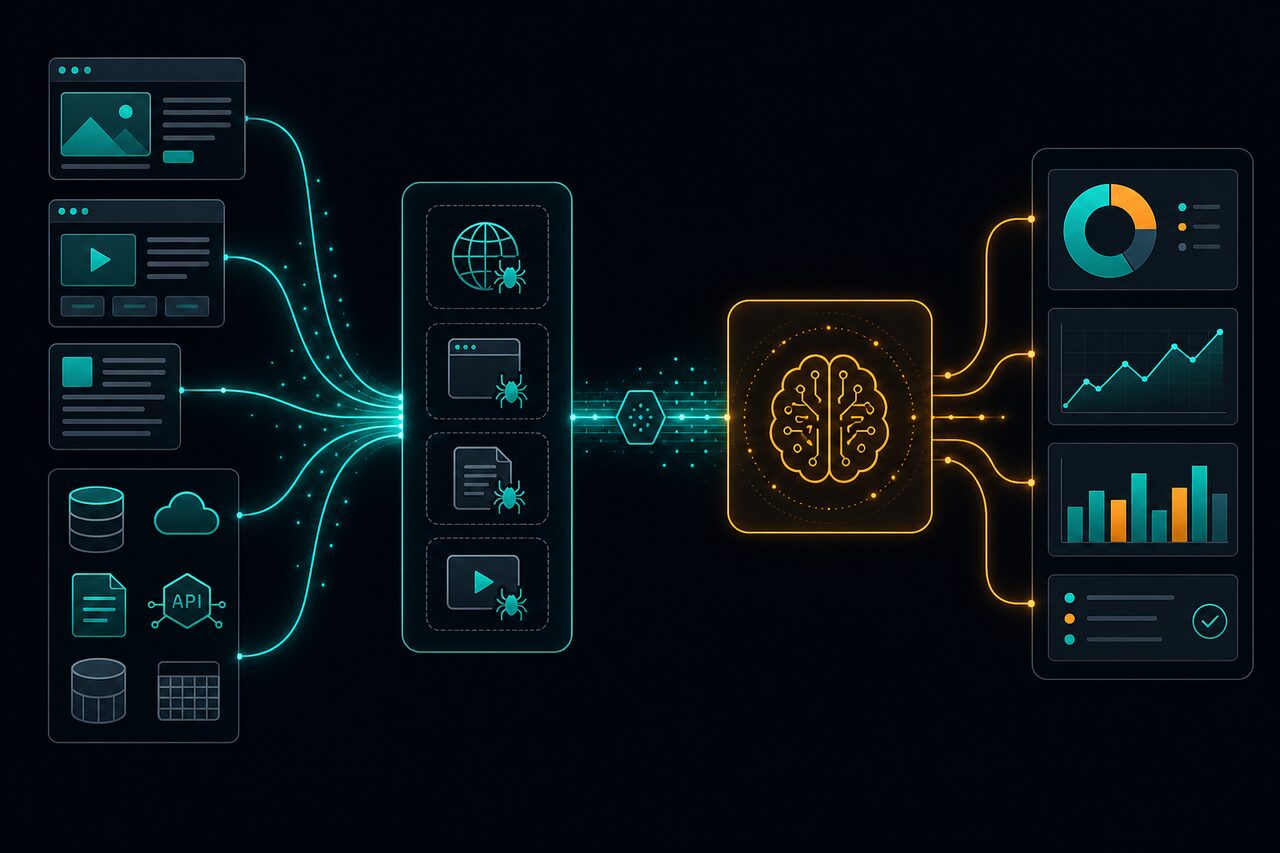
The final architecture is intentionally simple. When a user asks the agent a question that requires current information, the agent's planning step first decides whether it needs live data at all — a huge share of queries still don't. When it does:
- Step 1 — Search. If the agent doesn't have a specific URL in mind, it calls Firecrawl's search endpoint with a natural-language query and gets back ranked, freshness-filtered results with clean excerpts — no separate search API needed.
- Step 2 — Scrape or crawl. For a known target (a competitor's pricing page, a specific press release), the agent calls
/scrapedirectly. For "check everything this company has published in the last month," it uses/crawlacross a defined section of the site. - Step 3 — Agent-mode fallback. For genuinely open-ended asks — "find out if any of these five companies raised a round recently" — the request is routed to Firecrawl's own
/agentendpoint, which handles multi-source discovery without the client's agent needing to plan the search itself. - Step 4 — Synthesis. The retrieved, clean content is fed back into the language model's context alongside the original question, and the model produces a grounded answer with source links attached — never a bare, unsourced claim.
"The difference wasn't that the agent got smarter. It's that it stopped needing to guess. Every answer about something time-sensitive now comes with an actual source from this week, not a hunch from last year's training data."
— Engineering lead, client growth teamHandling the hard parts
A few details mattered more than the happy path:
- Caching and credit discipline. Repeated queries against the same source within a short window are cached rather than re-scraped, since Firecrawl's usage is credit-based per operation — this alone cut live-data costs by more than half without hurting freshness where it mattered.
- Graceful degradation. When a scrape fails (a blocked page, a timeout), the agent falls back to its own general knowledge but explicitly flags the answer as unverified against a live source, rather than silently presenting it with the same confidence as a grounded answer.
- Source attribution by default. Every synthesized answer carries the URLs it was built from, so a human reviewer can spot-check anything before it goes into a client-facing report.
The result
What used to be a multi-hour manual research task — opening a dozen tabs, cross-referencing competitor pages, checking news mentions — now runs through the agent in minutes, with the human analyst spending their time interpreting the synthesis rather than assembling it. Roughly 92% of the team's day-to-day research questions are now answered without any manual browsing at all, and the small remainder that still need a human touch are exactly the genuinely ambiguous, judgment-heavy questions where that's appropriate.
More importantly, the team stopped treating the agent's time-sensitive answers with suspicion. Once "how current is this" stopped being an open question, adoption inside the team accelerated on its own.
Want an agent that stays current, not just clever? We design and build real-time data pipelines like this one — Firecrawl-based or otherwise.
Start a project →